Why is your home’s tax assessment considerably different from what it could sell for? Below, we’ll break down how municipalities determine assessments, why those numbers often diverge from open-market prices, and what it means for you as a buyer or seller.
The Difference Between Assessed Value and Market Value?
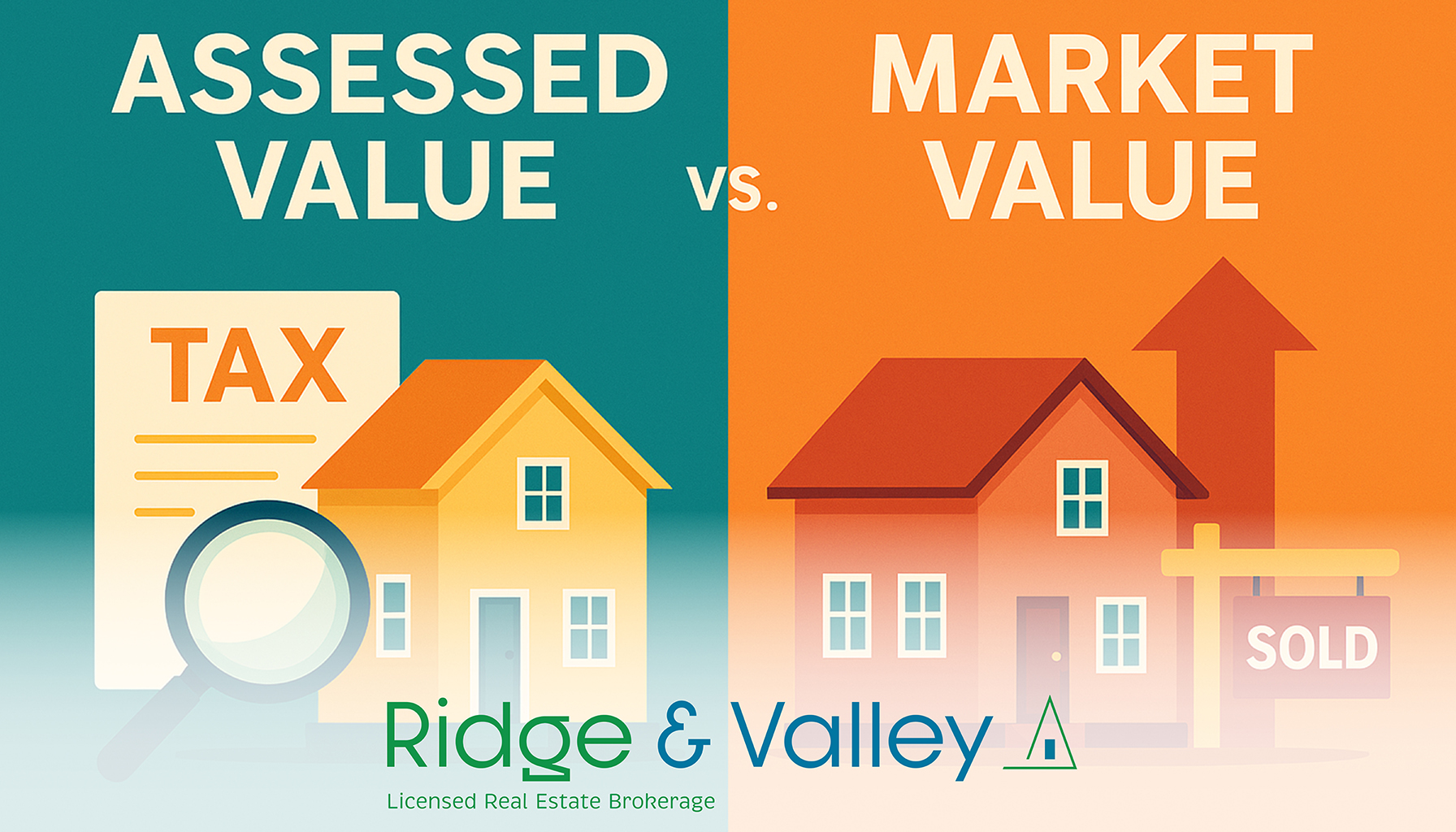
Market value is the price that you would expect to see on the open market, influenced by supply and demand, comparable sales, and the property’s features. By contrast, assessed value is an administrative number used by local governments to calculate property taxes. It’s assigned by a tax assessor and often lags behind current market conditions. In an ideal world, assessed value would equal market value; in reality, they frequently differ – sometimes dramatically. Assessed values may be deliberately set at a fraction of market value or may be outdated due to infrequent reassessments.
For example, a house that may fetch $500,000 today could have an assessed value of only $250,000 – or even $50,000 – depending on the locality’s practices. This doesn’t mean the assessor thinks your home is “worth” only that much; rather, it reflects the assessment ratio being used. Every jurisdiction has rules about the percentage of full market value at which properties are assessed. Understanding those rules is key to decoding your assessment.
New York’s Approach to Assessments: Fractional Values and Equalization
In New York, there is no statewide mandate that properties be assessed at 100% of their market value. Each city, town, or village (the assessing unit) can choose its own level of assessment (LOA) – for instance, 100% of market value, 50%, 10%, or any uniform fraction. State law does require that all properties are assessed at the same uniform percentage of value within any given municipality. In other words, if your town’s LOA is 25%, a house worth $400,000 should be assessed at $100,000, and a house worth $800,000 at $200,000, to ensure fairness. The idea is that relative values are consistent, even if the absolute numbers are lower than market.
Because different New York municipalities use different fractions (and may not update those fractions often), the state steps in with an equalization program. The equalization rate is New York State’s measure of a municipality’s total assessed value relative to its total market value. It’s essentially a correction factor. An equalization rate of 100 means assessments are at full market value; a rate of 50 means the town is assessing at 50% of market; a rate of 5.00 means assessments are only 5% of market value. State officials calculate these rates annually by estimating each locale’s total market value (using recent sales and appraisal models) and comparing it to the total assessed values on the roll. The equalization rate is used to apportion taxes fairly among municipalities that share taxing jurisdictions (like county or school districts) and to ensure state aid is distributed equitably. For property owners, the equalization rate and a related metric called the Residential Assessment Ratio (RAR) can also be used in assessment appeals to argue that your individual assessment is out of line with market values.
Bottom line for New York: Your assessed value might be a small fraction of your home’s true value, and that fraction can vary by town and year. There’s nothing nefarious about that – it’s a quirk of the system. New York’s solution to this patchwork system is equalization rates.
New Jersey’s Approach: Full-Value Assessments and the Chapter 123 Rule
New Jersey takes a different stance. The state constitution requires property to be assessed according to true market value (often called “full and fair value”). In fact, all 21 counties in New Jersey have adopted 100% of market value as the assessment standard. However, this doesn’t mean every home’s assessed value is up-to-the-minute market value – far from it. In practice, an assessor sets your value in a revaluation year, and that value typically stays the same in subsequent years until the next revaluation, even as the market moves. Over time, as real estate prices change, assessments drift away from true values.
To keep tabs on this drift, New Jersey uses an equalization mechanism of its own: the average ratio (often called the Director’s Ratio, determined by the state’s Director of Taxation each year). This ratio represents, for each municipality, the average assessed-value-to-sales-price ratio based on recent sales. For example, if on average properties are assessed at 80% of what they actually sell for, the Director’s Ratio is 80%. Each year, the state also defines a common level range for each town, usually 15% above or below that average, to gauge fairness. New Jersey’s Chapter 123 law (N.J.S.A. 54:3-22, passed in 1973) formalized this. If your property’s assessment falls outside that acceptable range around the common level, you have a strong case for an appeal.
Bottom line for New Jersey: Municipalities aim for 100% assessments at the time of revaluation, but those values can age and dip to a fraction of market value over time. The state’s Chapter 123 mechanism is a safeguard to ensure you’re not overtaxed just because the town hasn’t revalued recently.
Why It Matters to Buyers & Sellers
If you’re preparing to sell your home, you might wonder how (or if) the assessed value matters in that process. Here’s how to think about it:
- Pricing Your Home: In almost all cases, you should price based on market data (comparable sales), not based on your assessed value. As a seller, it’s best to treat assessed value as largely irrelevant to your home’s actual worth. Instead, use it as a conversation piece: if it’s low, it might reassure buyers about future taxes; if it’s high, be ready to explain that and even share if you’ve appealed it.
- Property Taxes and Buyer’s Perspective: Buyers will look at the property tax bill. In New York and New Jersey, property taxes are a significant carrying cost. A buyer might notice that a house is assessed far below the asking price. Their first thought could be: “Will my taxes jump if I pay this higher price?” Generally, the sale price does not automatically increase the assessment in NY or NJ. Whatever the sale price, the buyer will typically continue to enjoy the current assessed value until the next town-wide reassessment. However, you should also be candid if you know a revaluation is around the corner.
- Appealing an Assessment: This is particularly relevant for sellers because excessive property taxes (from an over-assessment) can be a drag on your home’s appeal to buyers. Both New York and New Jersey provide processes to challenge an assessment. In practice, a good rule of thumb: in NJ you won’t win an appeal unless you can prove your home is over-assessed by more than about 15%. In NY, any amount of over-assessment (over-market relative to LOA) is theoretically correctable, but small differences may not be worth the effort or might be within appraisal error. If you think your accessed value is out of line, you might contest the assessment before listing your home, so you can advertise a lower tax bill. If grievance deadlines have passed, you can also inform the eventual buyer how to appeal next year; being proactive can make your property more attractive.
Final Thoughts
The assessed value is primarily a tool for fairly distributing the tax burden; the market value is what you can sell your home for. Smart sellers focus on the market, but they don’t ignore the assessment. By understanding the gap between the two and the rules in New York and New Jersey, you can avoid surprises and make informed decisions. Both numbers have their place: one for the tax collector, one for the market. Knowing how they diverge puts you in a stronger position as a Buyer or Seller
Happy home buying & selling from the team at Ridge & Valley Real Estate!
Disclaimer:
This article is for general informational purposes only and does not constitute legal, tax, investment, or financial advice. Real estate markets and regulations vary by location, and every person’s financial situation is unique. Consult with a real estate attorney, licensed financial advisor, or CPA before making major housing or financing decisions. While we strive to ensure the accuracy of the data herein, market conditions and regulations can change, and any figures, links, or statistics cited may be subject to updates.
Sources: